
 By
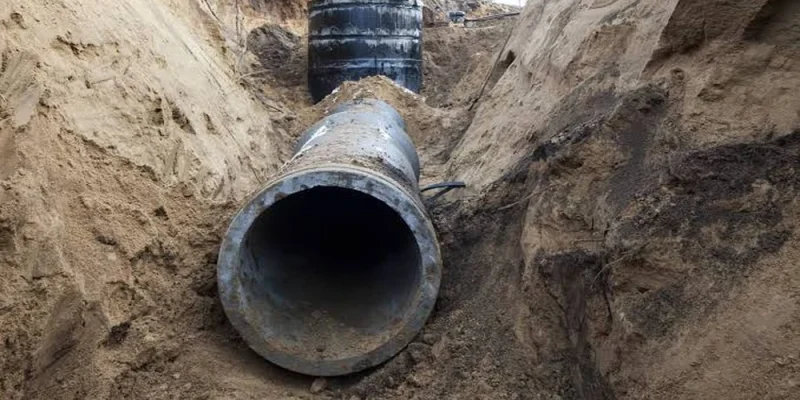
Ask a Denver homeowner where the water heater sits and the answer comes instantly. Ask where the sewer line leaves the foundation, how deep it runs, or what it is made of, and most people shrug. That buried pipe carries every gallon the household sends down a drain, often travels fifty feet or more before meeting the public main, and in most Colorado communities it belongs entirely to the person whose name is on the deed.
That ownership catches people off guard, and it is one reason Oasis Plumbing Co keeps its own excavation equipment rather than renting it by the job. Founded by master plumber Ed Gubrud on the idea of doing work right the first time, the Denver company pairs those machines with sewer cameras, electronic line locators, and trenchless replacement tools, so a problem buried anywhere in the metro area can be traced and repaired by one crew, day or night.
The dividing line is clearer than most owners expect. Denver maintains the public mains under the street, while the private service line, including its connection to the main, falls to the property owner. Nearby districts describe it the same way, and the Valley Sanitation District points out that the homeowner owns the lateral even where it runs beneath the road, and that many insurance policies exclude sewer backup damage.
Whoever Built the House Chose the Pipe
What lies underground depends mostly on when the home went up. The brick bungalows and Tudors of Park Hill, Washington Park, and the Highlands usually sent waste to the street through vitrified clay tile. Clay shrugs off corrosion, but it was laid in short sections with mortared or simple bell joints, and every joint is a possible doorway.
Homes from the late 1940s through the 1960s sometimes ended up with Orangeburg, a wood fiber tube soaked in coal tar that was cheap and plentiful after the war. With age it softens and slumps into an oval. Cast iron appears too, especially under basement slabs, where it slowly scales and rusts from the inside. Lines from the 1970s onward are usually PVC or ABS plastic, which lasts far longer but can still crack or pull apart at a poorly made joint when the ground moves.
Decades in Front Range Soil
Much of the metro area sits on clay that swells when wet and shrinks as it dries. Seasonal heaving nudges pipe sections out of line, leaving lips where paper and grease collect.
Trees make it worse. In a semi arid climate, roots chase moisture wherever they find it, and a weeping clay joint offers warm water all year. Rootlets as fine as hair slip through the gap, thicken, and eventually form a mat that fills the pipe. Uneven settling adds a third problem, letting a section sag into a belly where water sits and solids drop out.
The Basement and the Lawn Drop Hints First
Before sewage ever reaches a basement floor, the line usually sends signals. A floor drain that gurgles when the washing machine empties is a classic early warning, as is a toilet that bubbles while the tub drains. One slow sink points to a local clog, but sluggishness across several fixtures suggests trouble further out.
Outside, watch for a strip of grass that stays greener than the rest of the lawn in a dry August, a soft spot along the line’s likely path, or a walkway that has started to sink. Clogs that return a few months after every rooter visit may be the most telling clue of all, because they usually mean roots are regrowing through a damaged joint.
A Look Inside Before Any Shovel Moves
Diagnosis now starts with a camera fed through the cleanout on a flexible cable, recording the trip from the house to the main. A small transmitter near the camera head lets a locator on the surface mark position and depth with paint, turning a vague problem into an exact spot. The footage tends to reveal a handful of familiar defects.
- Root intrusion, showing as hairlike strands or dense masses at joints.
- Offset joints, where one section has shifted against the next.
- Bellies, revealed when the camera dips under standing water.
- Cracks and fractures, from hairline splits to missing chunks of pipe.
- Ovaling or collapse, the signature failure of aging Orangeburg.
That is why buyers of older homes increasingly order a sewer scope before closing, since a standard inspection rarely covers the lateral.
Dig, Line, or Burst
With the footage in hand, the repair choice comes down to the defect, the depth, and what sits above the pipe.
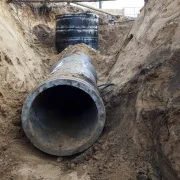
Open trench excavation is the most direct route. A crew digs down, removes the failed section or the whole line, and lays new pipe at proper grade. It is the only dependable cure for a belly, because the slope itself has to change.
Lining, often called cured in place pipe, pulls a resin soaked liner through the old line and hardens it into a new pipe inside the old one. It seals joints against roots and spares the yard, but it follows the existing shape, so it cannot fix a sag.
Pipe bursting drags a cone shaped head through the old line, cracking it outward while new pipe follows behind. It needs only a pit at each end and can even increase the diameter, though it suits straight runs away from other utilities.
The Tricky Few Feet at the Main
The connection where the private line enters the public sewer, called the tap, causes more than its share of trouble. It often sits beneath the street, sometimes eight feet down or deeper, and a cracked or separated tap lets in soil, groundwater, and roots. Fixing it usually means excavating in the public right of way, with permits and traffic control. Because the tap still belongs to the owner, the bill lands at home even though the hole is in the road.
Keeping the Next Fifty Years Uneventful
An accessible outdoor cleanout makes every future camera run cheaper and faster, so adding one to a house without it is money well spent. Thirsty trees belong well away from the line’s path, which a locate can mark before the next planting project. Wipes sold as flushable, cooking grease, and paper towels do not break down like toilet paper and snag on exactly the joints where roots are waiting.
Homes with basement fixtures below street level can benefit from a backwater valve, which stops a surge in the main from pushing sewage indoors. It also pays to read the homeowner’s policy closely, since backup coverage is often an optional rider and the line itself is rarely covered at all.
Above everything, the lateral rewards attention before it fails. A camera check every few years on an older clay or Orangeburg line costs a fraction of an emergency dig and turns a hidden pipe into a known quantity. The sewer line may never be visible, but its condition never has to be a mystery.





Comments